
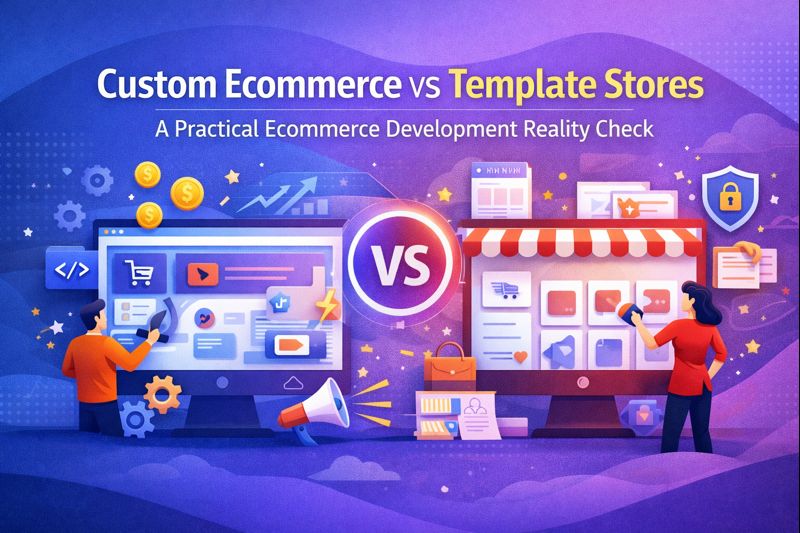
 By Harish
Understanding the Core Difference in Ecommerce Development
At a surface level, both approaches help you sell online. But when you look deeper, the difference between custom ecommerce vs template ecommerce lies in ownership, flexibility, and growth readiness.
Template stores are pre-built systems designed for speed and ease. Custom ecommerce solutions, on the other hand, are engineered around your business logic, customer journeys, and operational workflows. This distinction becomes critical as your store grows.
What Template Ecommerce Stores Are Really Designed For
Template-based ecommerce platforms are best suited for early-stage or low-complexity businesses. They prioritize ease of setup but impose technical and functional limitations.
Common characteristics of template stores:
- Fixed layouts and limited customization
- Platform-controlled performance and updates
- Dependency on plugins for advanced features
- Restricted checkout and user-flow flexibility
In the custom ecommerce store vs template store debate, templates offer convenience—but not control.
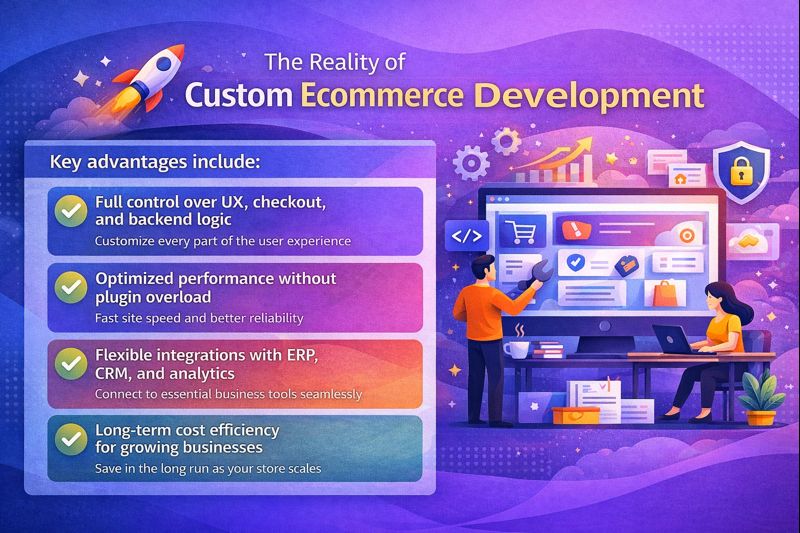
The Reality of Custom Ecommerce Development
Custom ecommerce development is built from the ground up to match your business model, not the platform’s limitations. It allows brands to design systems that scale with traffic, products, and customer expectations.
Key advantages include:
- Full control over UX, checkout, and backend logic
- Optimized performance without plugin overload
- Flexible integrations with ERP, CRM, and analytics
- Long-term cost efficiency for growing businesses
Custom development isn’t about complexity it’s about sustainability.
Custom Ecommerce vs Shopify Templates: A Clear Breakdown
When comparing custom ecommerce vs Shopify templates, Shopify offers speed and simplicity, while custom development provides adaptability and ownership.
Shopify templates work well for:
- Small catalogs
- Standard product flows
- Minimal customization needs
However, businesses often outgrow Shopify templates when they need:
- Advanced pricing logic
- Custom checkout flows
- Performance optimization beyond platform limits
- Deep backend integrations
This is where custom ecommerce becomes a strategic upgrade rather than a technical luxury.
Custom Ecommerce vs Ready-Made Ecommerce Solutions
The custom ecommerce vs ready made ecommerce comparison highlights a critical trade-off between speed and scalability. Ready-made solutions are built for the average business, not your specific one.
Limitations of ready-made ecommerce include:
- Feature dependency on third-party extensions
- Slower performance under heavy traffic
- Limited SEO and conversion optimization control
- Difficult long-term customization
Custom ecommerce eliminates these bottlenecks by design.
Ecommerce Development Comparison: Scalability, Cost, and Control
| Factor | Template Ecommerce | Custom Ecommerce Development |
|---|---|---|
| Setup Time | Fast | Setup Time Fast Planned & structured |
| Customization | Limited | Fully flexible |
| Scalability | Restricted | High |
| Performance | Plugin-dependent | Optimized |
| Ownership | Platform-controlled | Business-owned |
| Long-Term Cost | Increases over time | Cost-efficient at scale |
This ecommerce development comparison shows that templates save time early, while custom solutions save cost and complexity later.
When Does a Business Need Custom Ecommerce Development?
Not every business needs custom development from day one. However, custom ecommerce development becomes essential when:
- Your store handles high traffic or large catalogs
- You require unique pricing or checkout logic
- Performance and SEO are business-critical
- You plan long-term digital growth
At this stage, template limitations start impacting revenue, not just design.
Custom Ecommerce Store vs Template Store: The Growth Perspective
From a growth standpoint, a custom ecommerce store vs template store is not a fair fight. Templates are built for speed to market, while custom ecommerce is built for speed to scale.
If your goal is:
- Higher conversions
- Better customer experience
- Operational efficiency
- Platform independence
Custom ecommerce offers a stronger long-term foundation.
Final Reality Check: Which Ecommerce Model Is Right for You?
The real answer in the custom ecommerce vs template ecommerce debate depends on your business stage and goals. Templates are useful for validation and early sales. Custom ecommerce is essential for brands that want performance, ownership, and scalability.
If ecommerce is a core revenue channel not an experiment, custom ecommerce development is an investment, not an expense.
Thinking About the Next Step?
If you’re evaluating whether to upgrade from templates or planning a scalable ecommerce launch, understanding these differences early can save time, money, and technical debt later.
FAQ'S
Custom ecommerce development involves building an online store tailored to specific business workflows, user journeys, and scalability needs. Unlike template stores, it offers full control over design, performance, integrations, and future expansion without relying on pre-built platform limitations.
Custom ecommerce development is better for businesses focused on long-term growth, performance, and flexibility. Template ecommerce stores are suitable for quick launches, but custom solutions provide stronger scalability, optimized conversions, and complete ownership as business complexity increases.
A business should consider custom ecommerce development when template limitations start affecting performance, SEO, checkout flexibility, or integrations. High traffic, complex pricing, custom workflows, or growth-focused strategies often signal the right time to switch.
Custom ecommerce development allows platforms to scale efficiently by optimizing backend architecture, database handling, and frontend performance. Unlike template stores that rely on plugins, custom solutions are engineered to handle higher traffic and complex operations smoothly.
Yes, custom ecommerce development is worth the investment for growing businesses because it reduces long-term technical debt, improves conversion rates, and eliminates platform dependency. While initial costs may be higher, it often proves more cost-effective as the business scales.